This week Open Book (开卷) reported the Top Ten Bestselling Children’s Books in China in August 2026. Here’s the link to the page on WeChat. There were two middle-grade novels by well-established authors Shen Shixi and Cao Wenxuan, and two translations of works by Tetsuko Kuroyanagi (Japanese) and Bodo Schäfer (German) – all four of these have been bestsellers for a long time. The much-acclaimed movie Bronze and Sunflower released in May this year may have boosted sales of Cao Wenxuan’s novel. The other six books are from two extremely successful multi-volume series: three from the “Treasure Hunt” series, where each book focuses on a particular location (Quanzhou, Ningxia and Jilin), and three from the “Charlie IX and Duoduomo” series (nos 22, 30 and 31 in the series).
Jingding Animation: Treasure Hunting in Quanzhou (CITIC Publishing Group Co., Ltd) // 京鼎动漫:《泉州寻宝记》(中信出版集团股份有限公司) ISBN:9787521734898 (39.8元)
2. Leon Image: Duoduomo’s Mystery Adventure (31) – Whispers Under the Tree of Life and Death (Sunshine Edition) (China Peace Publishing Co., Ltd) // 雷欧幻像:《墨多多谜境冒险(31)-生死树下的窃语(阳光版)》(中国和平出版社有限责任公司) ISBN:9787513732093雷欧幻像 (25元)
3. Jingding Animation: Treasure Hunting in Ningxia (21st Century Publishing Group Co., Ltd) // 京鼎动漫:《宁夏寻宝记》(二十一世纪出版社集团有限公司) ISBN:9787556889884 (39.8元)
4. Leon Image: Duoduomo’s Mystery Adventure (22) – King Solomon’s Ring (Sunshine Edition) (China Peace Publishing Co., Ltd) // 雷欧幻像:《墨多多谜境冒险(22)-所罗门王的魔戒(阳光版)》(中国和平出版社有限责任公司) ISBN:9787513728669 (25元)
5. Shen Shixi: The Wolf King’s Dream (Upgraded Edition) (Zhejiang Children’s Publishing House Co., Ltd) // 沈石溪:《狼王梦(升级版)》(浙江少年儿童出版社有限公司) ISBN:9787534256301 (26元)
7. (Japanese) Tetsuko Kuroyanagi and Chihiro Iwasaki: Totto-chan: The Little Girl at the Window (2018 Edition) (Nanhai Publishing House) // [日]黑柳彻子,[日]岩崎千弘:《窗边的小豆豆(2018版)》(南海出版公司) ISBN:9787544288590 (39.5元)
English: Tetsuko Kuroyanagi, tr. Dorothy Britton: Totto-chan: The Little Girl at the Window
8. Jingding Animation: Treasure Hunting in Jilin (21st Century Publishing Group Co., Ltd.) // 京鼎动漫:《吉林寻宝记》 (二十一世纪出版社集团有限公司) ISBN:9787556882236 (39.8元)
9. [German] Bodo Schäfer: Ein Hund Namens Money (CITIC Publishing Group Co., Ltd) // [德]博多·舍费尔:《小狗钱钱》(中信出版集团股份有限公司) ISBN:9787521726473 (39.8元)
English: Bodo Schäfer: A Dog Called Money: A fun way to learn how to be wealthy and successful
10. Cao Wenxuan: Bronze and Sunflower (New Edition) (Jiangsu Phoenix Juvenile and Children’s Publishing House) // 曹文轩:《青铜葵花(新版)》(江苏凤凰少年儿童出版社) ISBN:9787534633362 (22元)
English: Cao Wenxuan, tr. Helen Wang, Bronze and Sunflower
The International Youth Library, Munich has just presented its annual White Ravens catalogue. This is a selection by the children’s literature experts at the IYL, and their supporters, of especially noteworthy books from the large number of review and donation copies the library receives in the course of the year. The team focuses on titles that might be of interest to an international audience because of their literary and pictorial quality and/or the topics they address.
For details of previous Chinese-language White Ravens, see our posts no. 111 (White Ravens 1984-2020), no. 133 (2021), no. 157 (2022), no. 162 (2023), no. 167 (2024), and no. 182 (2025).
Scroll down for this year’s Chinese-language White Ravens.
The 2026 White Ravens catalogue features 216 notable new children’s and young adult books from 62 countries and in 46 languages. There are 7 Chinese-language books and 1 Hokkien-language book. in the 2026 White Ravens catalogue (scroll down for details).
Rou gu cha xiang 肉骨茶香 (The fragrance of Bak Kut Teh), by Gasing Buku (Qi dian wen hua) (text), ZHENG Weizhen (illus.). Shah Alam, Selangor: Persatuan Kebajikan Tangan Sejati (Little Hands Action Charity Foundation), 2025. 28 pages. Age: 3+. ISBN 978-629-99685-6-6 // Keywords: Food | Bak Kut Teh | Worker | Coolie | History | Picture book
Summary: In her debut, ZHENG Weizhen introduces Bak Kut Teh, a popular dish in the city of Klang, Selangor, by following a little girl and her father to a restaurant. Bak Kut Teh translates from Hokkien as »meat bone tea«. It consists of pork ribs slow cooked in a rich broth made with spices and Chinese medicinal herbs. While the girl enjoys mouthwatering ingredients like pork feet and trotters, her dad explains the dish’s history. In the 19th and early 20th centuries, thousands of Chinese immigrated to work as “coolies” at the Klang docks or in Malaya’s tin mines and plantations. A local food stall owner, Lee Boon Teh, added Chinese medicinal herbs and seasonings into his soup for them. Legend has it that the locals named the dish after him. While Dad’s story ends, the girl finishes her meal with a full burp. They depart with takeaways, belly full, heart warm. Crucial to the ethnic identity of the Chinese community in an Islamic country, Bak Kut Teh was recognized as a Malaysian national heritage dish in 2024. [LO]
Wan wu sheng zhang 万物生长 (All things grow), by LIU Haiqi (text), ZOU Xiaoping (illus.). Tianjin: Xinlei chubanshe (New Buds Publishing House), 2025. 191 pages. Age: 10+. ISBN 978-7-5307-7975-0 // Keywords: Childhood | Moral education | Short story
Summary: This short story collection for children draws its title from a popular 1960s »red song« (revolutionary song), evoking the writer’s childhood and the spirit of childhood today. With his innovative narratives, LIU Haiqi deviates from the typical style and content of Chinese children’s fiction and its notions of childhood. Realistic images of children collide with contradictory moral concepts, revealing the vibrancy of a “red” generation’s childhood, and proving that, in any era, while the lives of children can be disciplined by mainstream ideologies, their innate free spirit still prevails. With rare precision and density, this collection reworks the era’s formal literary language and revives forgotten historical experiences. LIU Haiqi is a renowned publisher, former CBBY Deputy Chairman, and outstanding children’s author. His books include You gezi de xiatian and Wu wei xiao shu li xian ji. He won the National Award for Outstanding Children’s Literature twice and received the 2023 China’s Good Books prize. [FW, ZX]
Xue lu 雪鹿 (Snow deer), by PENG Yi (text), TIAN Yu (illus.). Nanning: Jieli chubanshe (Jieli Publishing House), 2025. 208 pages. (Series: Wu li wa la shu shu gushiji). Age: 10+. ISBN 978-7-5448-9443-2 // Keywords: Deer | Snow | Love | Fantasy fiction | Graphic novel
Summary: A snow deer that has saved a boy and his father is transformed into a little girl who comes knocking on their cabin door. Their bond continues to grow but at the price of the deer becoming invisible. This love story, told in the boy’s voice, is marked by a masterfully paced narration and genuine emotions. The illustrations blend the aesthetics of Chinese ink-painting with expressive, modern graphic-novel techniques. Blacks, whites, and greys create an atmosphere drawing on memory and myth, flowing in harmony with the text. This graphic novel was named a 2025 China’s Good Book and won the Canadian Applied Arts Award. PENG Yi is a celebrated fantasy writer, translator, and scholar. His works include the fantasy novel Yu you ling ca jian er guo and the picture book Xun lu ren de hai zi. He received the China Publishing Government Award. TIAN Yu’s picture books Qiao men xiao xiong and Chang bai sun received the Times Picture Book Award and the Laurel Children’s Book Award. [FW, ZX]
Dujiaoshou xianshen de chuntian 独角兽现身的春天 (The spring when unicorns appear), by Tongzi (i.e. ZHAO Zhongsheng) (text), JIN Zhaoxin (illus.). Jinan: Ming tian chu ban she (Tomorrow Publishing House), 2025. – 158 pages. (Series: Xin tong shi) Age: 8+. ISBN 978-7-5708-2549-3 // Keywords: Imagination | Language | Play | Poetry
Summary: This collection features nearly eighty children’s poems by Tongzi. They are marked by wild innocence, boundless imagination, playful surprises, and profound philosophical undercurrents. Composed in free form and flowing in rhythm, they delightfully alternate between the quotidian and a world of wonder, suggesting no dissociation between real life and fairy tales, everyday words and poetry. Halfway through the dream / I suddenly forgot who I was…I once threw a lion up into the sky / and it hasn’t come down yet…. Tongzi’s generation of authors has expanded the artistic expression and aesthetic scope of Chinese children’s poetry, while their seemingly aimless whimsy and ostensibly casual free verse also sparked debate. Should poetry for children be like this? Tongzi’s poetry collections include Chizu tiao lai tiao qu (Jumping about barefoot) and Wo zhi dao suo you wen ti de da an le (I know the answers to all the questions), the latter won the National Award for Outstanding Children’s Literature. [FW, ZX]
Aliya zhao baba 啊丽亚找爸爸 (Aliya looks for her Dad), by ZHOU Xiang (text/illus.) Ürümqi: Xin jiang qing shao nian chu ban she (Xinjiang Juvenile Publishing House), 2025. 46 pages. (Series: Beibei xiong tongshuguan) Age: 5+. Age: 7+. ISBN 978-7-5756-HOU0653-0 // Keywords: Xinjiang | Uyghur | Bazaar | Daughter | Aliya | Father
Summary: Aliya, a little Uyghur girl, eagerly follows her father to the grand bazaar to buy sheep. Afterwards, her father leaves to fix his vehicle, telling Aliya to wait. A startled horse and a rainstorm soon plunge the bazaar into chaos, and Aliya gets lost in the clamour and confusion of the vast market. But people notice her in her red dress and come forward to help, calling her father’s name until they find him, thus helping to reunite father and child. Earthy yellows and russet browns in the illustrations evoke a harsh but warm-hearted land where busy folk pause to help a child. ZHOU Xiang is a leading figure in promoting contemporary Chinese picture books. His best-known works include Hehua zhen de zaoshi (The morning market of Lotus Town) and Yiyuan qingcai cheng le jing (A garden of vegetables became alive). In 2023, ZHOU Xiang won Chinese Excellence in Children’s Illustration at the Bologna Children’s Book Fair. [FW, ZX]
Tongku Saveq. Taki Ludun tu Vazaz Tiang (Dong gu sha fei. Shan de haizi Di-ang) 東谷沙飛:山的孩子笛昂 (Tiang. Child of the mountain), by Neqou Soqluman 乜寇.索克魯曼 (text) Maoyu (i.e. CHIANG Meng-Yun) (illus.) Taibei: Si ye wen hua (SACCA Publishing Company), 2025. 56 pages. YA. ISBN 978-626-96841-6-8 // Keywords: Taiwan | Mountains | Ecology | Bunun | Picture book
Summary: The story follows young Tiang, who desires to climb Tongku Saveq, the sacred mountain of the Bunun people. Although his father – a high-altitude porter who wants to shield his son from backbreaking labour – is at first reluctant, they embark, together with the grandfather, on a trek that requires courage, responsibility, and physical stamina. Weaving in mythology, ecology, and ancestral wisdom, the narrative follows their ascent to the summit, where Taiwan’s breathtaking beauty unfolds. Illustrator Maoyu’s intuitive approach rejects stereotypical “tribal styles”; using coloured inks to interweave reality and fantasy, she depicts thin air, mist, textures of trees, rocks, mythical creatures and the well-defined calves of the hard-working Bunun. The book reflects the worldview of the Bunun and their desire to reclaim their sacred mountain. Author and illustrator have received numerous national and international awards. This book was awarded the TIBE Grand Prize 2026 for Children’s and Young Adult Literature. [LO]
Ke bu keyi shuo 可不可以说?(Can we say?), by Xi Xi (i.e. Ellen Cheung Yin / Zhang Yan) (text), Liu, Joanne (Liao Beien) (illus.) Taipei: Xiwang zhizao youxian gongsi (Hopology Publishing), 2025. 42 pages. (Series: Xi Xi shiji huiben xilie; 1) Age: 3+. ISBN 978-626-98257-6-9 // Keywords: Language | Norm | Rebellion | Poetry | Picture book
Summary:Ke bu keyi shuo pairs the literary imagination of the iconic late Hong Kong writer and poet Xi Xi (1937–2022) with the bold, whimsical visual storytelling of award-winning Hong Kong illustrator Joanne LIU. This celebrated poem has been adapted into a vibrant visual narrative where text and imagery engage in an entertaining exploration of language through a deceptively simple and rebellious poetic device: the deliberately incorrect assignment of measure words. By rearranging conventional phrases to name the world in unexpected ways, the poem subverts rigid grammatical norms and accustomed perspectives alike: “Can we say: A gourd of universe? A bloom of umbrellas? A bottle of Milky Way? A tail of an emperor?” Beneath this playful surface lies a more subversive intent to upend linguistic norms and question societal rules and world views. Joanne LIU’s imaginative illustrations bring this rebellion to life, transforming absurdity into acts of resistance against censorship, highlighting creative freedom and challenging hierarchies. [LO]
Na si leh sàng phue 若是咧送批 (If you were delivering letters), by Corn Chen (Yumi Chen, i.e. Chen Minyu) (text/illus.). Taibei: Yu shan she, Xing yue shu fang (Yushan Publishing, Star Moon Study), 2025. 90 pages. Age: 6+. ISBN 978-986-294-383-0 // Text in Hokkien (Taiwan Minnan) and Chinese. Keywords: Taiwan | History 1945-1992 | Political persecution | Prisoner | Letter | Poetry | Bilingual book | Leporello
Summary: This book by award-winning illustrator Corn Chen focuses on the recovery of state-censored farewell letters written by political prisoners facing execution during Taiwan’s authoritarian “White Terror” era. Faced with the question, “If you were delivering letters, what kind would you want to deliver?”, a postman vows to take care of these forgotten messages. He pedals across a magical landscape of old postal envelopes, until after sixty winters the letters finally become accessible and can be delivered to their rightful recipients. During his journey, he witnesses how these letters originate from “pitch-black fenced compounds”. letters have become undeliverable. The volume also includes letters and biographical accounts of five dissidents as well as essays on the White Terror period, encouraging readers to reflect on historical trauma and its relationship to present-day freedom. [LO]
We started Chinese books for young readers ten years ago this month! Thank you to everyone who has worked with us, writing posts, giving interviews, collaborating in so many different ways. We’re still here, and looking forward to more!
Interview with Christina Matula, author of the Holly-Mei books (13 May 2023) – link
More about teaching Mandarin in the UK, by Kate Titmuss (16 Aug 2023) – link
The Chinese Panda Book Awards – 34 winning titles since 2015! (13 Oct 2023) – link
The Chinese Panda Book Awards 2023-2024 – here’s the shortlist! (13 Oct 2023) – link
The 2023 White Ravens are here! (18 Oct 2023) – link
The Power of Chinese Narrative – interview with Sabina Knight (3 Nov 2023) – link
The 2023 Chen Bochui Award winners (16 Nov 2023) – link
The Chinese Panda Book Awards 2024-2025 – shortlisted titles (26 Sep 2024) – link
World Kid lit Month 2024 – GLLI focus on Taiwan (30 Sep 2024) – link
The 2024 White Ravens are here! – with ten Chinese-language titles (11 Oct 2024) – link
Interview with Jenny Bond – on the complex identities of Chinese girls who attended western Christian missionary schools in Republican China (20 Oct 2024) – link
The Astrid Lindgren Memorial Award – nominations from China and Taiwan (past and present) (10 Nov 2024) – link
“Perfect Picture Books” from Cardinal Media (23 Nov 2024) – link
The Bestselling Children’s Books in China, December 2024 (17Jan 2025) – link
Backbone of the Nation: 40 of China’s top scientist-academicians (22 Jan 2025) – link
Chinese children’s books in the UN Sustainable Development Goals Book Club – the full list (15 Feb 2025) – link
Bologna Ragazzi Awards – the eight nominations from China in the Sustainability category (25 Mar 2025) – link
FOUR WINNERS! – The Chinese Panda Book Awards 2024-2025 (23 Apr 2025) – link
The 12th National Awards for Outstanding Children’s Literature – 18 winning titles! (26 Jul 2025) – link
China Events at the Bologna Children’s Books Fair 2025 (24 Aug 2025) – link
August was the IBBY World Congress! And September is World Kid Lit Month! Here’s a quick round-up of some of the things we’ve seen!
Cai Gao received her Hans Christian Andersen Award (Illustration) at the IBBY World Congress in Ottawa, 6-9 August 2026. Congratulations, Cai Gao! (see our post 192) — more information about this award here
IBBY POSTER: The beautiful poster for the 2026 IBBY World Congress – in Ottawa, 6-9 August 2026 – is the creation of Canadian illustrators, Eric and Terry Fan, and features a Canadian moose and birds chirping 23 different languages! Read more about the poster design and the Fan brothers here – link.
We can’t help wondering if the IBBY Congress moose is a distant cousin of The Moose of Ewenki – by Gerelchimeg Blackcrane, illus. Jiu Er, tr. Helen Mixter (Greystone Books, 2019) ISBN 978-1771645386 – see our post 85)
SEPTEMBER IS #WORLDKIDLIT MONTH – It’s the 10th anniversary! Thanks to Jackie on the worldkidlit blog for including us on your post “10 best sites for world kid lit recos! – link Here’s a link to all the WKL blogs that mention Chinese books – link
YULU’S LINEN – by CAO Wenxuan, illus. Suzy LEE, tr. Helen WANG – thanks to Jackie Friedman Mighdol for studying it so deeply and sharing her thoughts about it in “I’d rather learn my life lessons in fiction” on substack!
YA LIT: China’s Missing Genre – The Struggle for YA Literature, by Yue (Cathy) Wang, on the Global Literature in Libraries (GLLI) website, 10 May 2026 – link
NEW BOOK: Youth in Chinese History: Educational Practices and Representations of Children and Young People between Tradition and Modernity, edited by Guilia Falato and Renata Vinci (Routledge, 2026) ISBN 9781041160502 — This project was supported by the British Academy and the Leverhulme Trust. Project website – link. Publisher’s website – link.
Qin, Junhan (2026). Development of Chinese and Foreign Picture Books from the Perspective of Publishing History, Social Sciences and Humanities 3 (3): 61–67. DOI: D10.63313/SSH.9084 – link
Reid, S.F., Yang, S. (2026). Analyzing Representations of Asian American Characters and Stories on the Book Covers of Newbery, Caldecott, and Printz Award-Winning Children’s and Youth Literature. Children’s Literature in Education (2026). https://doi.org/10.1007/s10583-026-09712-8
Sun, Q., Huang, C. I., Casey, K., Su, H., & Wang, T. (2026). Rates of Gender Representation in Children’s Literature Across Cultures: A Comparison of Chinese vs. U.S. Children’s Books. Early Education and Development, 1–18. https://doi.org/10.1080/10409289.2026.2720619 – link
Wee, S.J., Xue, M., Lo, Y. et al. (2026). Unpacking East Asian/Asian American Experiences of Racism and Microaggressions Portrayed in Children’s Picturebooks, Early Childhood Education Journal54, 1593–1606. DOI: 10.1007/s10643-025-01954-3 – link
We’re delighted to share details of this new book by Professor Frances Weightman, of the University of Leeds!
Marketing Chinese Children’s Books – Paratext and the Politics of Authorship, by Frances Weightman (Bloomsbury Academic, 2026 – Perspectives on Children’s Literature series) ISBN 978-1350273559.
The following details are from the publisher’s website:
DESCRIPTION: An exploration of the strategies used by Chinese children’s publishers to package and promote their authors, Marketing Chinese Children’s Books situates these approaches within their historical, social and cultural contexts and considers what implications this may have for publishers looking to market Chinese children’s books to global audiences. Focusing on the abundant paratextual elements of many contemporary Chinese children’s books, including prefaces, interviews, book covers and author photographs, this study reveals the various constraints on the self-fashioning of popular children’s authors in the People’s Republic of China today. Spotlighting some of China’s best-selling children’s authors – Cao Wenxuan (the first Chinese recipient of the Hans Christian Andersen Award), Yang Hongying, Shen Shixi and Gerelchimeg Black Crane – Frances Weightman considers how the marketing of these authors constructs and presents them variously as academic and political authorities; friends and confidantes; or trusted guides and gatekeepers of the natural world. This is a timely study of the construction of Chinese children’s authorship coinciding with the rapid expansion of children’s literature publishing in China and its reception on the world stage.
TABLE OF CONTENTS
Acknowledgements List of Illustrations Prologue Chapter 1: Producing and consuming children’s books in China today Chapter 2: Framing the Storyteller Chapter 3: Writing Childhood Chapter 4: Writing Authority Chapter 5: Writing the Wild: Harmony and Authenticity Chapter 6: Becoming Global Storytellers Epilogue Appendix Bibliography Index
On 27 April 2026 Professor Karen Sands O’Connor gave a fascinating presentation to Ocean University 中国海洋大学, Qingdao, China, titled “Prizing East Asia: British Children’s Publishing By and About East Asians.” She very kindly agreed to an interview with us.
Please tell us about yourself. What would you like our readers to know about you?
I’m a visiting professor with the University of Sheffield’s School of Education. I’ve taught literature classes for thirty years, mostly children’s and YA literature and the history of representation in British and American children’s books. Currently, I’m also the collections director of the Every Voice, Every Story (EVES) resource library, which is designed to help educators, librarians and caregivers understand the history of representation in Britain.
The Every Voice, Every Story Resource Library, currently being developed in Sheffield, offers a counterview of British children’s book history. Through thousands of children’s books from the 1780s onward, as well as educational materials, original illustrations and manuscripts, advertisements, children’s writing, and items from children’s popular culture, the collection focuses on historical and contemporary representations of minoritised communities: racially minoritised, but also those communities minoritised through class, gender, sexuality, religion, and ability. The collections include ‘classic’ texts, but also those which have been hidden by history, texts suggesting that positive representation of minoritised people and communities was neither absent nor, in some cases, rare. The aim of EVES is to highlight both historical racism and its continuing effects on children’s literature, and the alternative histories which have not typically been valued or recognised by standard and scholarly histories of children’s books. We offer workshops and seminars to teachers, librarians, and students of all levels to introduce these histories, and are open for scholars interested in doing research into representation in children’s books. [Source: Listening to Every Voice and Every Story: EVES Resource Library and Research Collection, Dublin City University MA in Children’s and Young Adult Literature blog, 28 Apr 2026]
People working on East Asian/Chinese children’s books often have personal connections with the language and/or culture – could you tell us about your own journey towards East Asian/Chinese children’s books?
Really, I’m just at the start of my journey. I’ve worked with doctoral students from China recently, and learned a lot from them, including about the plight of Left Behind children. I became interested in expanding EVES’ collections to include more material that demonstrated the way that British writers represented China and Chinese people—as well as the way that Chinese people and British Chinese people are starting to represent themselves in children’s literature published in the UK and US.
The structure of your presentation gave a chronological survey of interests and attitudes (positive and negative) first towards China and Chinese things and then towards Chinese people. Could you elaborate on the motivations of those involved in the creation of some of the books you mentioned? The authors, the illustrators, publishers, reviewers, booksellers, etc?
It’s impossible to know what motivated people from the past, but one can definitely see trends. In the 19th century, travel to China by ordinary Britons was uncommon, and therefore children’s books showed a real curiosity about what the country was like. The Hyde Park exhibition of Nathan Dunn’s Ten Thousand Chinese Things in the 1840s allowed British people to ‘know’ China through objects such as clothing, weaponry, religious items and artwork, but actual Chinese people remained unknown to most British people right through the beginning of the 20th century. Artists like Walter Crane, who admired Chinese and Japanese art, copied the style in some of his work, particularly his version of Aladdin. But at the turn of the century, fears about Chinese immigration and its effects on British and American workers led to the idea of ‘Yellow Peril’ and this created and cemented many stereotypes about Chinese people in popular media—including children’s books. It took the efforts of British authors travelling to China and Chinese authors in Britain (and their panda friends) to correct some of these stereotypes and bring us the wealth of quality children’s books that exist today.
I’d like to ask about international interaction in the academic field of children’s books. As a leading scholar, having received a BA travelling professorship, you are perhaps uniquely placed to comment on how international the field is?
There isn’t enough international interaction. Of course, the International Research Society for Children’s Literature (IRSCL) and the International Board on Books for Youth (IBBY) hold conferences, but European and North American scholars often have an easier time attending these conferences because they don’t tend to have the visa or financial considerations that some other countries’ citizens might face. And long-term international collaboration is difficult to fund and (in the current global political climate) often unpopular. Britain, for example, has restricted postgraduate student visas; and the British Academy programme that brought me to Britain is no longer awarding fellowships. I think we need to make more use of global connectedness, through online lecture series (the University of Wrocław has an international speakers series – the International Voices in Children’s Literature Studies series – and of course Ocean University in China also brings in international speakers, among others)—but we should also be finding ways to collaborate online. I’m currently developing an exhibition on migration, and I’m hoping to be able to include international scholar interviews to move the exhibition beyond Britain’s boundaries.
Munyaradzi Mawere, The Struggle of African Indigenous Knowledge Systems in an Age of Globalization. A Case for Children’s Traditional Games in South-Eastern Zimbabwe (Langaa RPCIG, 2012) [Source: Project Muse]
An additional concern, and one academia in Europe and North America will have to get to grips with, is that there are ways of understanding, evaluating and producing knowledge that simply aren’t acknowledged in or valued by traditional academic structures. Colonial hierarchies of knowledge and people continue to prevent us from being truly international. Sandy Littletree’s work on Indigenous Systems of Knowledge offers ways of rethinking fields such as librarianship and archive study, and Munyaradzi Mawere has written about African systems of knowledge in relation to children’s games. These are just two examples, but I think scholars in Europe and North America, particularly those from former imperial cultures, need to take time out to consider how indigenous scholars can improve our understanding of children’s literature around the world.
There has been an intense focus on developing children’s books in China in the 21st century. Almost all prizewinning books from around the world have been translated into Chinese. This makes China a unique place to study the world’s children’s books. Could you develop your last answer with specific regard to China?
Unfortunately, I think it is still quite a one-way street. I’ve had fantastic Chinese students in my classes, and known Chinese scholars in Britain as well, but I think some of the ‘mysterious unknown’ stereotypes still hang on when it comes to British people thinking about China. Speaking with Chinese students has made me interested, not just in children’s books, but in thinking about language and philosophy as well and the ways that these shape children’s books and child readers. China has, as you say, translated the world’s prize-winning children’s books, but how many Chinese children’s books (prize-winning or not) are translated into English by British and North American publishers? In Britain, this is beginning to change through the work of illustrators like Yu Rong, who is keen to increase the number of Chinese translations in the UK, and to help authors and illustrators work together across cultures (see our post no. 142). But this work requires the awareness and willingness of publishers, teachers, librarians, and booksellers to get these books into children’s hands.
Five Chinese Brothers, by Claire Huchet Bishop, illus. Kurt Wiese (Putnam Publishing Group, 1938)
Please tell us about your own childhood reading. Any favourite books? Do you associate your early reading with any particular people or places?
I was lucky enough to be brought up in a household that valued books; my brothers and sister and I all had our own bookshelves, and we made weekly trips to the library (sometimes more in summer). But there weren’t many Chinese stories for kids in 1970s America that were free from stereotypes, especially not contemporary realism. I read a lot of folktales, and this included Claire Huchet Bishop’s retelling of the Chinese folktale Ten Brothers (her version only had five brothers). Huchet Bishop’s retelling included problematic illustrations by Kurt Wiese, but the story—of brothers who had supernatural powers and used them to cheat death—stuck with me. I only recently discovered that the Chinese version of the story has a greater emphasis on cooperation and on thwarting the exploitation of labourers working on the Great Wall. This is a good example of a story that I think would have real resonance in English-speaking countries at the moment, and maybe someone will publish a new version for children!
Any weblinks/staff page/social media you would like to share?
BOOK NEWS – The Water Flower. The Journey of a Lotus Seed, by Yingting CHEN, illus. by Huaqing, tr. unnamed (post wave, 2025) ISBN 978-1836270188. The Chinese original 《一顆蓮子的生命旅程》was a White Ravens 2022 (see our post no. 157). Yingting Chen 陈莹婷 graduated from the Institute of Botany, Chinese Academy of Sciences, and has authored several books about plants. Huaqing 花青, born in Shanghai, studied in the Chinese Painting Department of the China Academy of Art, and has master’s and doctoral degrees in fine arts from Chinese National Academy of Arts. — link
NEW BOOK – Otter’s New Neigbors, by LI Xingming, tr. Shan Chen (Charlesbridge, 2026). ISBN 9781623547554 – link
INTERVIEW – “Meet the Author-Illustrator: Li Xing-ming on Loneliness and Connection” – interview by Wang Li, WorldKidLit, 25 May 2026 — link
EXHIBITION: “Ed Young’s Bright Worlds – Gesture and Feeling in 60 Years of Picture Books for Children”, at the Museum of Chinese in America, New York, 14 May – 13 Sept 2026 – link. This exhibition is part of MOCA’s Luminaries for America250, a yearlong celebration of Chinese American historymakers at the Semiquincentennial – link – Ed Young (YANG Zhicheng 杨志成) (1931-2023).
EXHIBITION REVIEW: ‘Ed Young’s Bright Worlds’: Creating a Retrospective Exhibition. Review by Krystyna Poray Goddu, Publishers Weekly, 2 July 2026 – link – Ed Young (YANG Zhicheng 杨志成) (1931-2023).
MOVIE: Bronze and Sunflower (2025) was released in China on 8 May 2026. To see trailers on Youtube etc, search for “Qingtong & Kuihua” (which means “Bronze & Sunflower”). At the Golden Rooster Awards 2025, it was nominated for Best Children’s Film (Kun-Hou CHEN) and Best Editing (Ching-Sung LIAO).
BESTSELLERS – The Top Ten Bestselling Children’s Books in China, May 2026 – The release in China of the movie Bronze and Sunflower on 8 May 2026 sent Cao Wenxuan’s novel of the same title to the No.1 and No.2 spots (by two different publishers) on OpenBook’s list of Children’s Bestsellers. The two publishers are Jiangsu Juvenile and Children’s Publishing House, and Foreign Literature Press [but the ISBN indicates Tiantian Publishing House]. At No. 7 was A Dog Named Money, by Bodo Schäfer, tr. Wen Yi (CITIC Publishing House Co. Ltd). The other seven titles in the Top Ten were in the massively-popular “Treasure Hunting” 大中华寻宝系列 series, by Jingding Comic, published by 21st Century Press Group. (Source: Erin L. Cox, China Bestsellers, May 2026: Screen Adaptations Drive Book Sales, Publishing Perspectives, 26 June 2026 – link)
Bronze and Sunflower, by CAO Wenxuan (Jiangsu Juvenile and Children’s Publishing House, 2005) ISBN 978-7534633362 // 曹文轩:《青铜葵花》江苏少年儿童出版社
Bronze and Sunfower, by CAO Wenxuan (Foreign Literature Press, but ISBN indicates it should be Tiantian Publishing House, 2015). ISBN 978-7501609413 // 曹文轩:《青铜葵花》天天出版社
Treasure Hunting in Beijing, Jingding Comic (21st Century Press Group, 2023) ISBN 978-7556869589 // 京鼎动漫 : 《北京寻宝》21世纪出版社集团
Treasure Hunting in Jilin (21st Century Press Group, 2024) ISBN 978-75568822236 // 京鼎动漫 : 《吉林寻宝》21世纪出版社集团
Treasure Hunting in Shanghai (21st Century Press Group, 2023) ISBN 978-7556869572 // 京鼎动漫 : 《上海寻宝》21世纪出版社集团
Treasure Hunting in Ningxia (21st Century Press Group, 2025) ISBN 978-7556889884 // 京鼎动漫 : 《宁夏寻宝》21世纪出版社集团
[Kira and] A Dog Named Money, by Bodo Schäfer, tr. Wen Yi (CITIC Publishing House Co Ltd, 2020) ISBN 978-7521726473 // 博多·舍费尔, 文燚 : 小狗钱钱(出版20周年珍藏纪念版) 中信出版集团
Treasure Hunting in Shanxi (21st Century Press Group, 2023) ISBN 978-7556878871 // 京鼎动漫 : 《山西寻宝》21世纪出版社集团
Treasure Hunting in Shaanxi (21st Century Press Group, 2023) ISBN 978-7556869664 // 京鼎动漫 : 《陕西寻宝》21世纪出版社集团
Treasure Hunting in Hainan (21st Century Press Group, 2023) ISBN 978-7556869831 // 京鼎动漫 : 《海南寻宝》21世纪出版社集团
UPDATE 8 July 2026 – added 2 items: Exhibition Review and Movie
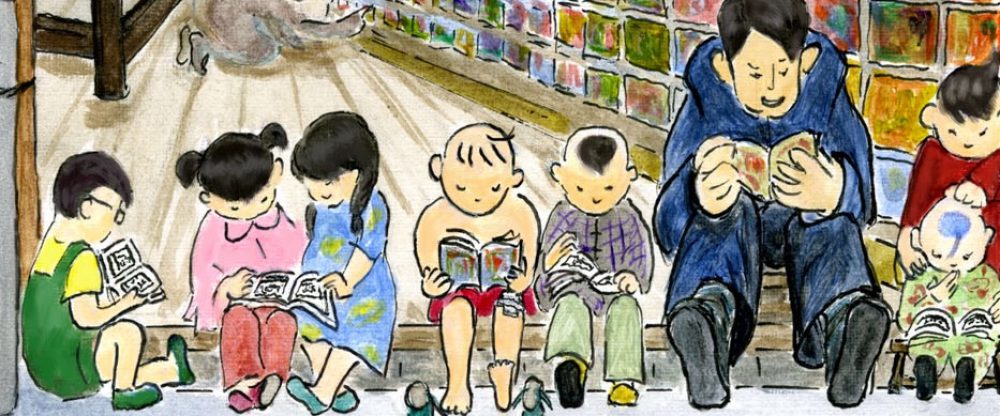
We often ask our interviewees about their childhood reading, so I was interested to see an article that looked at what five very well-known Chinese authors – Lu Xun, Zhou Zuoren, Zhang Tianyi, Wang Anyi and Shen Congwen – read when they were young. The article was published on Children’s Day (1 June), 2017. I’ve summarized and edited it below.
In October 2016, we posted about the “For Children” series (给孩子系列) – with the poet Bei Dao 北岛 as series editor – published by CITIC Press (中信出版社 中信出版社·活字文化 中信出版集团) (see post no. 9). At that time, five volumes had been published. An initial series of ten was planned, described as “A Liberal Arts Introductory Course Designed by Poet Bei Dao Specifically for Chinese Children” (“给孩子” 第一辑:诗人北岛专为中国孩子打造的博雅启蒙课 www.chinawriter.com.cn 30 July 2018)